Showing posts with label sauce. Show all posts

10 May 2011

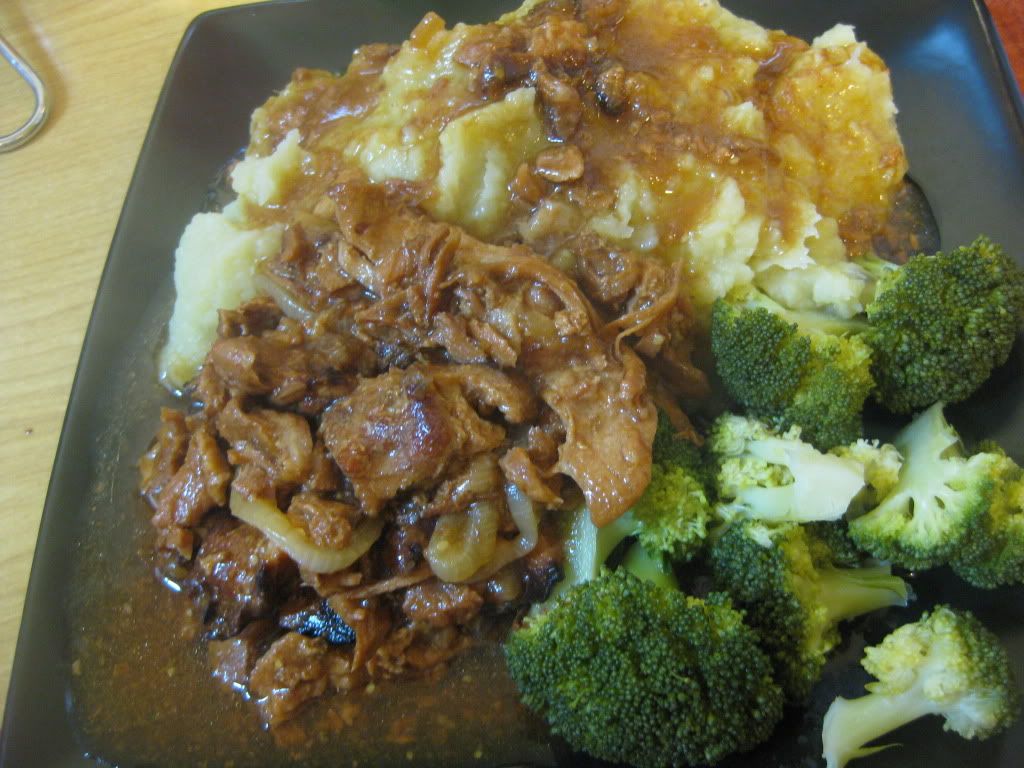
Slow-Cooked Pork in Beer

Apparently writing blog posts in one's mind doesn't automatically mean that you're being an active food blogger.

This recipe was inspired by a recent event in which beer - in glass bottles - was accidentally left in the freezer for about twenty-four hours. Although no disasters occurred, there was quite a lot of fizzing once they'd been safely retrieved, which meant we were left with 1500ml of very flat beer. For a while I lamented our lack of a slow-cooker, and then pulled myself together and did it anyway. The meal was super-easy, super-tasty, and based very (very) loosely on the little I could remember from SmittenKitchen's brisket recipe, after cooking it once, more than a year ago.

I used Hite, a Korean brand of lager; if you try something else, let me know how it turns out for you.


Slow-Cooked Pork in Beer
Serves 4

1 tablespoon oil
3 onions (3rd is optional)
1 tablespoon brown sugar
800g lump of pork
2 tablespoons ketchup
750ml beer (with extra to top up if necessary)
1 teaspoon chilli powder
Seasoning

17 February 2011

Mole Enchiladas

I continue to disappoint myself by forgetting to take pictures of certain meals. For this particular meal, I have no excuse: I photographed most of the process, popped the enchiladas in the oven, served them up, and greedily ate them, without even a thought for the camera that was sitting, sad and alone, right next to where the food was served up. So you're going to have to make do with the pre-oven picture, which is still a nice picture.

Mole is a Mexican sauce which I thought was basically a savoury dark chocolate sauce. (Oh, and it's not pronounced like the animal, but with an é.) I was quite wrong, as this recipe shows. I toned down the recipe a bit but still ended up with enough sauce to freeze for another meal. I served it with a slightly modified version of my enchiladas - modified in that no salsa was made, but the necessary flavourings just added to the meat instead - and really enjoyed it. The mole sauce feels earthy. There's no other way to describe it. Despite the excess amounts of spice added, it wasn't burn-your-mouth spicy, which I liked but Tom didn't.

Mole Enchiladas
Serves 2, with enough sauce for 4

Enchiladas:
1/2 onion
1 garlic clove
250g minced pork (or beef, or chicken)
2 cups tomato sauce
1 tablespoon mayonnaise
1/2 teaspoon turmeric
Chilli powder
1 tin kidney beans
4 tortilla wraps
1/2 cup grated cheese
Seasoning

Mole Sauce:
1/2 onion
2 garlic cloves
2 large green chillies
1 cup tomato sauce
1 cup chicken stock
2 tablespoons peanut butter
1/2 teaspoon cinnamon
2 squares dark chocolate (mine was 56% cocoa)
1 teaspoon hot sauce or ssamjang
Chilli powder
Seasoning

11 January 2011

Strawberry Mustard Chicken with Roasted Cauliflower

I've joined another food-blog website, called Tasty Kitchen and headed by the indomitable Pioneer Woman. Browsing through the recipes, I found a raspberry dijon chicken, which sounded fascinating - but not quite right for me as it is. For one thing, it's not difficult enough. And I don't have a barbeque. And it doesn't have a sauce! What's wrong with the world? I had to fix this.

And so I thought for a day or so, and came up with: strawberry (I don't have raspberry jam) mustard chicken, roasted in the oven with cauliflower, with a red wine gravy made from the juices. The strawberry/mustard glaze risked being far too sweet, particularly as I originally conceived this dish as a summery take on shepherd's pie (which I may still do later in the year), so I needed something slightly bitter to balance everything out. And thank god for that cauliflower in the freezer. I enjoyed cooking this, though my camera battery died when I went to take a picture of the glazed chicken breasts nestled in a bed of blanched cauliflower pre-roasting, so there's no proof of how easy it was. Sorry!

I served ours with rice, and it was delicious. Tom wasn't a huge fan of roasting cauliflower, as he felt that it spoiled the usually-crunchy texture of the vegetable too much. If you dried the florets thoroughly after blanching, and roasted them in a pan on their own with more oil, they might have gone crispy to make up for this huge disappointment - but that's too much work for a 10pm meal. I, on the other hand, thought it was delicious. I love cauliflower even though I find it a hint too bitter sometimes, but the roasting seemed to draw out the flavour rather than the metallic sourness of the vegetable. It still balanced the possibly-too-sugary fruitiness wonderfully, but without making anyone wince.

Regarding substitutions: obviously I've not tried any myself, having only cooked the original dish about fourteen hours ago, but I can imagine that different meats would react differently to the glaze. Chicken breasts just soak up flavour rather than adding any of their own, so it was a good one to start out with. Chicken thigh might not be as forgiving. Beef would be superb with this, at least in my mind - you wouldn't have to add the cauliflower because of the beef's own bitterness, and the red wine gravy would do wonders for it as well. Also, I can imagine a stupendous vegetarian version, or simply glazing the cauliflower and calling it a side dish. Let me know if you try anything different!

Funnily enough, this meal is really quite easy. And it sounds impressive! Cook it now - with or without chicken.


Strawberry Mustard Chicken with Roasted Cauliflower
(Printable Recipe)
Serves 2

Half a head of cauliflower
3 chicken breasts
1 tablespoon jam (mine was strawberry)
1 tablespoon mustard
(basically you want 1 teaspoon of each per breast)
1/2 tablespoon oil
1 tablespoon gravy powder
1 cup red wine
1 pinch each chilli powder and cinnamon
1 teaspoon parsley
Seasoning

Break the cauliflower into small florets and put in a pan of boiling water on a high heat for five minutes. In the meantime, mix jam, mustard and oil in a bowl and add seasoning. Cover each chicken breast in the glaze, place in an oven-proof tray large enough to hold the chicken and cauliflower, and drizzle any left over on top.

Drain the cauliflower and nestle around the chicken. Cover liberally with oil, salt and pepper, and roast at 180 degrees (360 Fahrenheit) for thirty minutes. In the meantime, prepare your side dish (I just put rice on to boil and went back to the very important business of sitting around doing nothing.)

When the chicken, cauliflower and rice are cooked, serve and keep warm. Put the roasting tray on the hob on a low heat and stir to loosen all the sticky bits. Sprinkle one tablespoon of gravy powder into the pan and stir, followed by a cup of red wine. Add small pinches of chilli and cinnamon, one tablespoon of parsley, and stir until slightly thickened and hot. There isn't too much of the sauce but it is very flavoursome - you don't need much. Pour over the chicken and some of the rice, and eat.


04 January 2011

Oven-Fried Chicken and Hasselback Potatoes

Yesterday I felt very much like Nigella as I decided to marinade some chicken for dinner about three minutes before we had to leave for work. If only I'd been wearing a lower-cut top, with mood lighting rather than brash sunlight, and a camera crew ready to put everything I needed within arm's reach. Instead I was rushing maniacally around my nonetheless tiny kitchen, grabbing and shaking and stirring and trying to reassure Tom that it would only take a second longer.

Dinner was delicious, and taken from recipes here and here. I've done Hasselback potatoes before, but in the spirit of my only real New Year's resolution (which is to make a bit more of an effort with this blog, in case you couldn't tell) I'll write up the recipe again. With pictures! Oooooh.

You may have noticed a new 'Recipes A-Z' at the top of the page. I'm not sure it's entirely easy to use at the moment, so please comment if you have any suggestions for improvement. Also, if you click on the title of a recipe and then scroll down to the bottom of the recipe, you should see a list of related recipes that might interest you.

In other news, I received Niki Segnit's The Flavour Thesaurus as a late Christmas present, and - wow. Just wow. In a few days I might have gotten over my infatuation with the book enough to talk about it like a normal human being talks about books, but for the moment I'm just going to wallow in my crush.

Oven-Fried Chicken

3 chicken breasts
200ml milk
1 tablespoon lemon vinegar
1 teaspoon lime juice
3 finely chopped garlic cloves
Small handful of chopped onion
1 teaspoon mustard
Spice (I added a teaspoon of ssamjang and a hefty handful of chilli flakes)
1 teaspoon cinnamon
Seasoning

4 crackers
1 slice of bread
1 handful grated cheese
Sprinkle of chilli flakes
1/4 cup flour
2 grindings of black pepper

Mix the milk with the lemon vinegar and lime in a bowl, and leave to stand while you get the other ingredients out. Chop the garlic cloves and onion (I probably used about a quarter of an onion) and add to the slightly-curdled mixture. Add mustard, spice and cinnamon, and stir everything through. Dump the chicken in, turn to coat in the marinade if necessary, cover the bowl, and leave for work.

The chicken should sit in the marinade for at least three hours - mine sat for about eight. In a separate bowl, crumble the crackers and bread and mix with the cheese, chilli flakes, flour and pepper. I used a blender to whizz everything together to make a very fine dust which coated the chicken remarkably evenly.

Marinaded chicken ready to be coated.
Pick up each chicken breast and shake a little to get off any excess drops. Dredge in the coating and put on to a baking tray. If you want the coating to go properly golden, dot some butter on top of the chicken - I forgot to but was nonetheless perfectly happy with the results.

Waiting to go in the oven.
Bake at 200 degrees (390 Fahrenheit) for thirty minutes.

In the meantime, pour the marinade into a heavy-bottomed pan on a low heat. Stir frantically to decrease the likelihood of making flavoured ricotta. After about five minutes, it can be left on the heat to reduce - I left it for about ten minutes until the sauce was the consistency I wanted. Add seasoning, and herbs if wanted. I served this sauce on the side of the meal in a separate bowl in case it was disgusting, but it was actually really nice and added some less-subtle spice to the meal.


Hasselback Potatoes

6 small potatoes
Oil (lots of oil)
Butter
Seasoning

Put each potato in a wooden spoon and cut across at intervals. The wooden spoon will stop you from cutting all the way through, so each potato will fan out as it cooks.

Chopping the Hasselback.
Put onto a baking tray and cover liberally in oil, salt and pepper. Cut small pieces of butter and put one on top of each potato (which should be cut-side up). Roast for forty-five minutes at 200 degrees (390 Fahrenheit), adding more oil halfway through if you think the potatoes don't look crispy enough. Bigger potatoes will take more time, and crispier potatoes (my boyfriend's eternal desire) will also take longer. Serve.

Dinner is served.

01 January 2011

Golden Tomato Sauce

Happy New Year!

We've been away! And you can read all about it here. Sadly I have no food information to add to my experience, because we ate sandwiches that we'd brought with us, except for when we ate sweet and sour pork from a Chinese restaurant. I ate almost all of the crescent pastries. Those are definitely on the make-again list. (One thing that isn't in the travel blog, though, is how much time I spent in the car daydreaming about bacon jam. Bacon jam. I can't wait to make bacon jam.)

So we got back and I decided to make tomato sauce from scratch, because we'd bought some mini golden tomatoes on Wednesday and I was too excited to wait any longer. I've made tomato sauce from scratch before and loved it; the recipe from 101 Cookbooks has been calling out to me for a while.


Golden Tomato Sauce
(Printable Recipe)
Makes 2 servings

About 30 golden mini tomatoes
(the package doesn't have a weight label on it!)
2 garlic cloves
1 teaspoon tomato paste
3 teaspoons herbs (optional)
Seasoning

Slice each of the tomatoes in half and run your finger along the inside to get rid of the seeds. Keep the seeds in a small bowl for later.

Seed liquid, halved tomatoes, and more tomatoes waiting to be deseeded.
Either chop your tomatoes and garlic finely, or be a cheat like me and blend them together (in two batches). Transfer the mixture to a pan and heat through on low, adding tomato paste and herbs if desired. I would have left the sauce as it was, but Tom isn't the world's biggest tomato fan, so I added a teaspoon each of basil, oregano and parsley to liven things up a bit for him. Season to taste.

If the mixture gets too thick for your liking, add the seed liquid, one teaspoon at a time. After a few minutes the sauce will be cooked - cook for longer if you want it to be further reduced.

26 December 2010

Christmas Food

Christmas!

Sadly Christmas does not seem to be that big a deal in Korea, but that wasn't going to stop us from going all-out. We spent about twenty-five pounds on a giant slab of beef, drank buck's fizz from 9:30, had monkey bread for breakfast, and cooked enough so that we could recreate Christmas dinner again today from the leftovers, if we felt like it. And probably tomorrow, too.

Also, one of my Christmas presents was a pair of pink spotty pyjamas, so now I really am a cook in pink pyjamas. I'm very happy about this.


Monkey Bread leftovers in tupperware - we needed the cake tin!

Christmas Breakfast: Monkey Bread
Fills one cake tin

2 and 1/2 tablespoons butter
1 cup milk
1/3 cup water
1/4 cup brown sugar
4g instant yeast
3 and 1/4 cups flour (I used 1 and 3/4 bread flour, 1 and 1/2 wheat flour)
2 teaspoons salt
1 tablespoon oil
More flour (I estimate about 300g)
150g butter
Equal amounts brown sugar and cinnamon

Put the milk and water into a medium-sized, microwavable bowl, and heat on a medium temperature in the microwave for one minute. Add the two and a half tablespoons of butter and return to the microwave for another thirty seconds to a minute so that the butter melts into the mixture. Add the quarter-cup of brown sugar and the yeast and stir to combine.

In a big mixing bowl, stir the flour and salt together. I used two different kinds of flour because the first packet was empty after 1 and 3/4 cups! Make a well in the middle of the flour and pour the milk mixture in. Stir with a wooden spoon until the dough has formed, and is quite sticky - this shouldn't take long at all.

Sprinkle a lot of flour on to a clean surface, heavily flouring your hands as you do so, and tip the dough on to it. The original recipe says to "lightly flour" your work surface, but I found that I needed to use probably 300g of flour to get it to the right consistency. Keep the flour nearby and a clean hand (I used Tom's) ready to sprinkle more for you if necessary. Knead the dough until it is smooth and satiny, incorporating any scraps that come apart during the kneading. The original recipe says this should take about ten minutes; for me it took about seven.

Pour most of the oil into a large ovenproof bowl and swish it around (I used my hands to make sure it covered the bottom and sides of the bowl thoroughly). Put the dough into the bowl and cover it with a little more oil. Cover the bowl with foil and put it in the oven at 50 degrees C (120 Fahrenheit) for twenty minutes, after which you can turn the heat off and leave it for another forty. By now it should have doubled in size.

Remove the foil from the bowl and tip the dough on to a work surface - this time the work surface does only need a light dusting of flour. In one bowl, melt the 150g butter; in a second, mix equal parts brown sugar and cinnamon (you can cut back on the cinnamon as much as you like, but Tom is a big fan of it so I went full-on). Pull small pieces from the dough and shape them into balls, about an inch and a half in diameter (bigger than a two-pound coin but smaller than a golf ball). Dip each ball into the butter, then the sugar mixture, and then put back into the ovenproof bowl. I stacked mine to make a pyramid, not bothering with using a fork to dip each ball in the melted butter.

The dough needs to rise again: I covered the bowl with clingfilm and left it on the side overnight (it had at least thirteen hours). The original recipe suggests putting it in a pre-heated then turned-off oven for another fifty to seventy minutes.

When the dough has risen and you are ready to eat, remove the clingfilm from the bowl and put it into an oven at 180 degrees C (360 Fahrenheit). Cook for thirty minutes, leave for five, and then start tearing the whole thing apart. Delicious when warm, but somehow even better when cooled. Very doughnut-esque. It would be wonderful to adapt the dough slightly by lowering the amount of sugar, and making a savoury version with olive oil, herbs, garlic and cheese instead.


For dinner itself we had roasted beef with roast potatoes, pumpkin mash (having forgotten to buy sweet potatoes), cauliflower cheese, pigs in blankets, Yorkshire puddings, broccoli, and mulled wine gravy. The pigs in blankets were simply sausages rolled in bacon and put in the oven for twenty minutes, and the pumpkin mash was made in exactly the same way as normal mash. Sadly it was very watery so we didn't eat much of it, but it should make great leftovers soup. The Yorkshire puddings are very much Tom's area of expertise so I have neither recipe nor experience to share. Our roast potato recipe remains unchanged since Thanksgiving, so here are my beef, cauliflower and gravy recipes. (We were so excited to see cauliflower in Tesco. It was the first time we'd seen it since we came here. Like a Christmas miracle!)


Roasted Beef
Serves 6

1.5kg beef, no bone
2 onions
Oil
Seasoning

In a large oven tray on the stove, heat some oil. Add the beef and sear on all sides. Add the onions, peeled and quartered, and put in the oven at 180 degrees (360 Fahrenheit) for one hour. Lower the temperature to 150 (300 Fahrenheit) and cook for a further two hours for rare meat.


Cauliflower Cheese
Serves 4

Half a head of cauliflower
1 tablespoon butter
1 tablespoon flour
2 cups milk
1/2 cup white wine
1 teaspoon mustard
1 teaspoon cream cheese
1 handful grated cheese
1 cracker
Parmesan dust
Seasoning

Chop the cauliflower into florets and boil at a high heat for five to ten minutes. Drain and transfer to a small baking tray. In the pan, melt some butter and add the flour to form a roux. Add the milk to the roux, whisking thoroughly, along with the wine. Allow the sauce to simmer for a moment. Add the mustard and cream cheese, waiting until both have melted into the sauce before removing the pan from the heat and adding the grated cheese. Stir the sauce through for a few minutes before returning it to the heat and adding parmesan dust and seasoning to taste. Pour over the half-cooked cauliflower and sprinkle grated cheese and crushed cracker over the top. Bake for twenty minutes at 180 degrees (360 Fahrenheit).


Mulled Wine Gravy
Makes about 200ml

Roasting juices
Gravy powder
Red wine
Seasoning

This recipe is necessarily very vague because the amount of roasting juices you get varies massively, as well as the number of people you're hoping to feed with this gravy. Below are my rough estimations, given that I made gravy for two with only a tiny bit left over. You may want to add more or less for taste, also. The mulled wine ice-cube could be replaced with other flavourings, such as mustard or horseradish.

After the beef, or other roasting meat, has been removed from its pan in preparation for carving, take the pan to the stove and put it in a low flame. My roasting juices had the two braised onions in it. Add about one tablespoon of gravy powder, one cup of red wine, one mulled wine ice-cube, and seasoning. Stir. Allow the sauce to bubble for at least five minutes, or until it is needed, before pouring into a jug or gravy boat for serving.
28 November 2010

Thanksgiving: The Rest (part 3)

This is the final Thanksgiving post today, and will detail the sauces, chutney, and dessert I made. All of which were really quite good, if I do say so myself.

Persimmon Chutney
From this recipe

4 persimmons
2 tablespoons ginger tea
1 tablespoon honey
1/2 teaspoon cinnamon
1/2 teaspoon chilli powder

I peeled and diced the persimmons before putting in a pan on a high heat with the ginger tea, honey and cinnamon. Once the mixture started bubbling slightly, I lowered the heat and stirred the chilli powder through. After about fifteen minutes the chutney was solid and sticky, and good to taste. Unfortunately I can't tell you much else about it as I completely forgot to serve the chutney and it is still sitting forlornly on top of the microwave.

Gravy
Makes about 600ml

150ml duck and chicken fat
100ml red wine
200ml beef stock
1 onion from the chicken cavity
Seasoning

We had a lot of fat reserved from roasting both birds, which had been added to a jug (and cooled) over the course of the day, so simply put it in a pan. It heated for a few minutes before the red wine was added, and a few minutes later so was the beef stock. The gravy was tasted and seasoned accordingly. It was still too thin at this stage, so we put it on a higher heat to reduce, and added one of the onions which had been roasted inside the chicken. There was way too much gravy but it was absolutely delicious.

Black Raspberry and Cranberry Sauce
From this recipe

2 cups black raspberries
1 handful dried cranberries
3 bay leaves
Rosemary
Thyme
1 teaspoon sugar
1 tablespoon chopped onion
100ml red wine
1 teaspoon spiced rum
Salt

I mixed the raspberries, cranberries, bay leaves, rosemary, thyme and sugar in a bowl and left to marinade for half an hour. Fried the onion in oil, added the wine and rum to the pan, and then set the alcohol on fire with a lighter - which was bloody scary. I shrieked. And panicked when I realized that I was using a wooden spoon. Surely it would catch on fire! Luckily it didn't, so I tipped the raspberry mixture into the pan with a little bit of salt (I added too much and had to remedy it with a bit more sugar), allowing it to heat through and reduce slightly. The original recipe suggests blending the sauce but I preferred it to remain thicker, so I settled for stirring roughly and bashing up the fruit a bit in the process. I removed the bay leaves before serving. This sauce was delicious but probably superfluous, as I was the only one who really had any of it.


Pumpkin Pie
From this recipe
8 servings

9 chocolate biscuits
1/2 cup butter
1 tablespoon milk
Pumpkin puree (made earlier this week)

I'd started this recipe on Wednesday morning by making the pumpkin puree; I continued it on Friday night, which I was actually quite proud of. I did something in advance! Anyway, I crushed the biscuits, mixed them with melted butter and milk, and used the mixture to line a pie dish. This went in the fridge overnight. I hate dough and pastry so a cheesecake base seemed to be the best way to go. On Saturday morning I poured the puree on to the crust and baked it for thirty minutes at 180 degrees C (360 Fahrenheit).

Rum Cream


2 tablespoons butter
2 tablespoons rum
150ml cream
1 teaspoon sugar

Imagine how stupid I felt after yesterday's post, when I realized that the Pioneer Woman's Hard Sauce is actually just brandy butter.

I had had a little bit of wine by the time it came to making the cream for dessert, so unfortunately the two tablespoons of rum became quite a bit more, and the cream became fairly potent. I had left the butter to soften out of the fridge for a while, and then blended it with the rum, cream and sugar before serving with the pumpkin pie. Absolutely delicious.

11 November 2010

Chicken with Mustard Sauce

This week, I've been re-doing recipes rather than trying new ones. Unfortunately, the cheap passata we bought was more like ketchup than tomato sauce, so a second attempt at Tunisian chicken was disgusting. Yesterday, I mixed milk and broccoli pesto to retry the amazing pesto chicken, which worked pretty well but wasn't worth creating a whole separate post for. Basically, pesto + creamy sauce = delicious. And easy.

Tonight was a third night of chicken, inspired by (not really adapted from) this recipe at BBC Good Food. We served it with rice, which is bland anyway, but this dish did lack something. I'm not sure what, and it was perfectly pleasant - I could have had more afterwards - but... yes. Not a meal to impress.

The good news, however, is that this is the first time I've successfully made mustard sauce!

Chicken with Mustard Sauce
Serves 2

Handful of chopped onion
2 chicken breasts
1 tbsp flour
2-3 cups milk
2 tsps cream cheese
1 tbsp parsley or other herb(s)
1 splash white wine
3 tsps wholegrain mustard
Seasoning

The onion was fried in hot oil for a few minutes before the chicken was added, to seal on each side. The flour was sprinkled over and stirred through to make a loose roux, and the milk added. The heat was turned up until the milk was on the point of boiling before being lowered again. Cooked through for ten minutes before the cheese, parsley, wine and mustard were added. Stirred and cooked for another ten minutes until the chicken was no longer pink in the middle. Served over rice.

31 October 2010

Happy Hallowe'en!

This food is too good to be eaten only at Hallowe'en. Both came from the BBC Good Food website, and were delicious. The toffee apple wedges were particularly spectacular, and so easy! We have leftover sauce and have frozen it to make into caramel-esque shards. The sticky chicken and pumpkin was going to be served with an attempt at Nigella's rostini (fried gnocchi as quick roast potatoes!) but our substitute had begun to grow mould, so we had it with pasta instead.

Toffee Apple Wedges
Serves 2; from this recipe

Large lump of butter
Lots of brown sugar
250ml cream
1 large apple
Lemon juice
Cinnamon
More sugar

I melted the butter over a low heat and added enough sugar to heavily coat the bottom of the pan. This mixture became quite mud-like but after some stirring on the heat, it starts to get more liquidy. At this point I added the cream and whisked quickly with a fork over high heat for about five minutes so it thickened a bit. The mixture was left to cool. The apple was cut into wedges and tossed in lemon juice, cinnamon and sugar. Once the butterscotch mixture had cooled a little, we dunked the apple wedges and ate them without grilling.

Sticky Chicken and Pumpkin
Serves 2, from this recipe (very much adapted)

2 chicken breasts
1 small pumpkin (ours was green and slightly avocado-esque - very odd)
2 garlic cloves
1 onion
2 sweet potatoes
Chilli powder and thyme
Between 1/2 and 1 glass of black raspberry wine
Balsamic syrup
Vegetable stock with added gravy powder
Small pack of walnuts
Honey
Seasoning

I chopped the pumpkin into bite-sized pieces, the garlic into teeny bits, the onion into about eight wedges and the potatoes into chunks. Mixed in a pan with the chicken, seasoning, thyme and chilli powder, and fried for just under five minutes. Added the wine and a lot of balsamic syrup. Mixed some dried vegetable stock with gravy powder, added 300ml boiling water, and poured into the pan. Added just enough water to nearly cover the vegetables. Brought to a boil and left to simmer for twenty minutes. Broke the walnuts into pieces and added to the pan, along with some honey. Reduced further until the sauce was thick and sticky and served with pasta.

27 October 2010

Ssamjang sauce

Another day, another Nigella recipe...

Today was a strange day for food. I ate the leftovers of my beef pumpkin stew for first lunch (about noon), made a small risotto with leftover rice and Korean black raspberry wine (it was delicious, and pink!) for my second lunch at about 8:30, and had Korean dumplings with noodles and an adapted version of Nigella's ssamjang sauce for dinner. The sauce was really spicy but also really nice. I think I would add some melted peanut butter next time.

Ssamjang sauce
Serves 2

1 tsp oil
1 cup soy sauce
3 tsp ssamjang
1 squirt honey
1 glug of black raspberry wine (which is Korean red wine to be perfectly honest)
1 tbsp orange juice
Small handful of chopped onion
Seasoning

Mixed the ingredients in tupperware. Cooked the noodles and dumplings separately. Drained the noodles and put them back in the pan with this sauce until the sauce was heated through. From idea to plate in under ten minutes!

26 October 2010

Chicken, Mash and Greens

We were running pretty low on food last night, and as we were both working till 10 neither of us were feeling the 'cooking' that much. After finding some curly mallow in the fridge, and this recipe on the internet, and discovering that I wanted mashed potato, dinner was easy. And delicious. Tom was less enthusiastic about the meal but I really enjoyed the flavours.

Unfortunately, my head is currently full of tonight's dinner and I'm not sure how much of last night's I can remember. I knew I should have written it down at the time!

Chicken, Mash and Greens
Serves 2 (with an extra serving of mashed potato)

2 garlic cloves
2 chicken breasts
1 handful of curly mallow
Oil
Curry powder
Vegetable stock
Milk
Sugar
1 handful of broccoli
Seasoning

6 or 7 potatoes
Vegetable stock
Milk
Butter
Seasoning

Chopped 2 garlic cloves and sliced the mallow into long strips. Mixed in a pan with chicken, oil, curry powder, vegetable stock and seasoning. Put on a low heat and stirred until browned. Made 300ml of vegetable stock with boiling water and a very tiny bit of milk - the amount I used didn't even cover the whole bottom of the jug. Poured in half and cooked for about ten minutes. Added the broccoli, more of the stock, and poured the rest of the stock into the potato pan. Added some sugar to taste and kept on the heat until the broccoli was cooked through and the sauce had reduced a little. It was still very thin but thick enough to eat.

In the meantime, Tom peeled the potatoes and boiled them with a little bit of vegetable stock and seasoning. I mashed them with lots of milk and butter and more seasoning.

08 October 2010

Peanut Sauce

I've decided to add a new label to my blog: oven-free. Living in Hawai'i and South Korea, where ovens are scarce, and to a lesser degree when I was unable to use the main oven in Germany, I've had to make a lot of stovetop meals (and will be making more for a while to come yet). It's difficult to find meals that satisfy a no-oven requirement, and time-consuming, because often you have to read the entire recipe to find out what the food is cooked in. Since I started reading food blogs about a year ago, I have been wishing that my favourite websites would include an oven-free category, and what other way to make this happen than to start the trend myself!?

Last night we tried Korean rice pasta, which was quite stodgy and flavourless, with Korean dumplings (all store-bought). We did, or rather I did, make our own peanut sauce though, with a mixture of cinnamon and chilli flavourings. Here it is.

Spiced Peanut Sauce
Serves 4ish

Butter
1 onion
Half a jar of peanut butter (I used crunchy)
Milk
Chilli and cinnamon spices
Seasoning

Chop one onion, and fry one-third to one-half of it in butter. Add the peanut butter and the milk (for however much sauce you are serving - less, thicker sauce is better than more thin sauce) and stir until the peanut butter has melted. Add more peanut butter and/or milk if necessary. Add one-third to one-half of the onion - if there is any left, save it for another meal. Simmer until heated and quite thick. Add some chilli and cinnamon spice along with seasoning, stir, and leave to incorporate on the heat for a few minutes. Serve.

I also used my risotto recipe for lunch today, although experimented with a flavour mixture of balsamic and thyme. Unfortunately, I overdid it on the pepper, so can't really report on the success of that combination yet.

05 September 2010

Two meals

Lunch:
Pasta salad for two.

Two large handfuls of pasta, boiled with salt for 10 minutes.
Sauce: normally I use a dip as the base, but we didn't have any today, so I made one from scratch. I mixed natural yoghurt with 1 egg and some mayonnaise before putting it on the heat. Added 1 tsp honey, 1 tsp mustard, salt+pepper, more mayonnaise, remoulade and salad cream. Also dusted Parmesan.
Pasta was run under cold water and mixed with sauce. Most of one raw chopped onion was stirred through.

Sauce wasn't quite right but good enough.

Dinner:
'Meatballs' in fresh tomato sauce with pasta, cooked for five/six-ish with some leftovers.

I basically followed the recipe, although I didn't have carrot and celery. After simmering it for fifteen minutes, I put the pasta on (one 500g packet). Fifteen minutes later, the pasta was nearly ready; I cut six Frikadellen (pre-cooked hamburger-esque German things) into eighths and stirred them through to warm them. It was lovely, the sauce was a teeny bit sour, but the whole thing was AMAZING and so more-ish with dusted Grana Padano. Mmmmm.